
There is a version of your brand that exists without your input. It lives in Google search results, customer reviews, social media comments, and increasingly — in the answers that ChatGPT and Perplexity give when someone asks about a business like yours. That version is what most people see before they ever contact you.
Online Reputation Management is the discipline of taking control of that version. It is no longer optional — it is the foundation on which consumer trust, search visibility, and business success are built.
What Is Online Reputation Management?
Online Reputation Management (ORM) is the process of monitoring, influencing, and shaping how a brand, business, or individual is perceived across digital platforms.
It covers:
- What appears when someone searches your brand name on Google
- What reviews say on Google, Trustpilot, Justdial, and industry platforms
- What your social media presence communicates about you
- How your brand appears in AI-generated answers (ChatGPT, Google AI Overviews, Perplexity)
- How media coverage and forum discussions represent you
ORM is often misunderstood as “responding to reviews.” That is one small part. A complete ORM programme combines SEO, public relations, content marketing, social listening, and crisis communication — working together to shape everything a stranger sees when they look you up.
ORM vs. PR vs. SEO — How They Connect
Many students and business owners confuse these three, so here is the clearest way to understand the relationship:
PR (Public Relations) handles media coverage and the narrative (mostly through journalists, press releases, and earned media).
SEO (Search Engine Optimisation) improves the rank of your website and content in search results for specific keywords.
ORM sits at the intersection of both. It uses SEO techniques to push positive content higher in search results, uses PR techniques to shape media narratives, and adds review management, crisis response, and social monitoring on top.
In digital marketing, ORM is best understood as the reputation layer that sits above all other channels. Your SEO can rank you well, and your ads can drive traffic — but if your ORM is poor, people who search your brand name see negative reviews, bad press, or unanswered complaints before they ever reach your website.
As businesses increasingly rely on AI-powered search and customer reviews, learning Online Reputation Management has become an essential part of digital marketing. A Digital Marketing Course that covers ORM, SEO, and AI-driven search strategies can help professionals stay ahead.
The 2026 Shift: AI Is Now a Reputation Channel
This is the most important development in ORM in 2026, and very few guides cover it properly.
According to BrightLocal research, 45% of consumers now use AI tools like ChatGPT for local business recommendations — up from just 6% in 2025. That is a 7.5x increase in a single year. ChatGPT processes approximately 1.1 billion queries daily, with 800 million weekly active users.
What this means practically: when someone asks ChatGPT “which digital marketing agency in Jaipur is trustworthy?” or “is this hotel in Rajasthan good?”, the AI generates an answer based on information scraped from reviews, forums, news sites, and content across the web. If your brand’s online presence is weak or negative, AI tools reflect that — and the user never even makes it to your website.
Traditional ORM focused on Google search results. In 2026, effective ORM must also account for how your brand appears in AI-generated answers. This is sometimes called AI citation management or Generative Engine Optimisation (GEO) within an ORM context.
Online Reputation Management in Digital Marketing
ORM is a core component of digital marketing, not a separate discipline. Here is where it fits:
- Content marketing generates positive, authoritative content that ranks above negative results
- Social media marketing maintains active, professional brand voices that build trust
- Local SEO ensures business listings, reviews, and map results are accurate and positive
- Email marketing helps generate genuine reviews from satisfied customers at the right moment
- Crisis communications responds to negative events before they dominate search results
Every digital marketing channel contributes to or is affected by reputation. ORM is the strategic thread that runs through all of them.
The ORM Strategy Cycle — How It Actually Works

Rather than a random list of tactics, think of ORM as a repeatable six-step cycle:
Step 1 — Audit: Search your brand name, your founders’ names, and your key products. What appears on the first two pages of Google? What do your reviews say? What is your average rating across platforms? This baseline tells you what you are actually working with.
Step 2 — Claim and Build Owned Properties: Create and fully complete all your brand profiles — Google Business Profile, LinkedIn, Facebook, Instagram, YouTube channel, and any relevant directory listings. Owned properties rank well in search and give you control over what appears near the top of your brand results.
Step 3 — Monitor: Set up ongoing monitoring so you know every time your brand is mentioned online. Use tools (covered below) to track new reviews, news mentions, and social comments in real time. You cannot manage what you do not see.
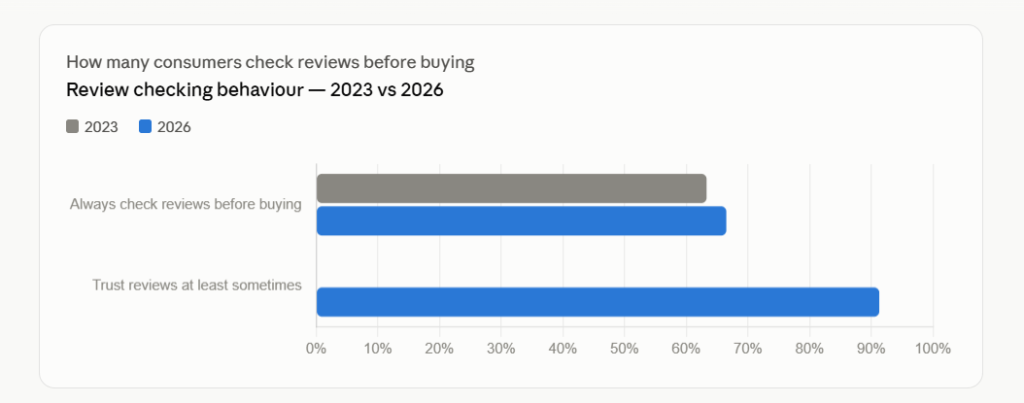
Step 4 — Response and Generation of Reviews: According to a Reputation/Prodege survey of 2,000 US consumers (fall 2024), 54% of consumers trust online reviews first — more than friends and family (24%), company claims (18%), or social media influencers. That trust is only growing: 91.3% of consumers now trust online reviews at least some of the time, and 66.5% always check reviews before making a purchase — up from 63.3% in 2023 (Inc.com, 2026). Review signals are projected to account for 20% of local search ranking factors in 2026.
Step 5 — Suppress Negative Content: When negative content exists, the ORM response is not deletion (which is rarely possible) — it is suppression. Publishing high-quality, optimised positive content pushes negative results off the first page over time. This is where SEO and ORM overlap directly.
Step 6 — Measure: Track your average rating, review volume, first-page search results composition, and sentiment scores monthly. Reputation improvement is measurable — and should be measured.
Advantages of Online Reputation Management
Here is why businesses and professionals invest in ORM — with real data behind each point:
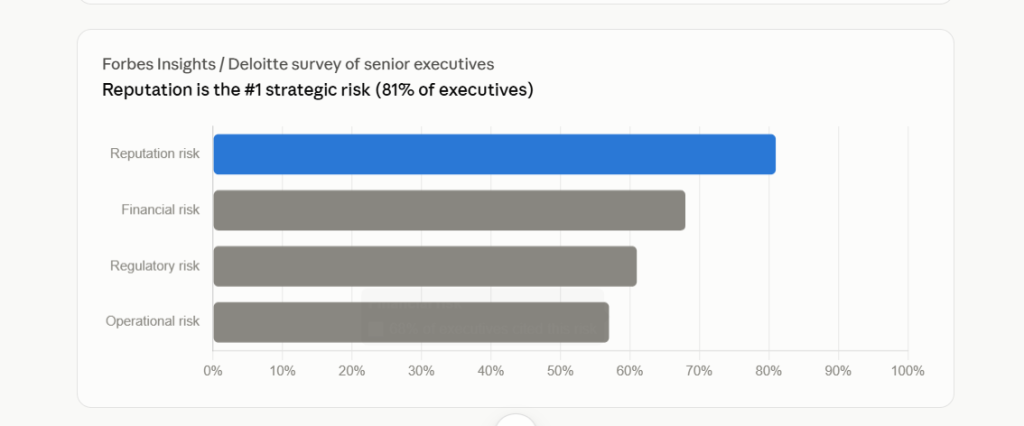
1. It directly affects revenue. A Forbes Insights/Deloitte survey found 81% of senior executives identified reputation as their number one strategic risk — above financial, regulatory, and operational risks. Reputation damage is expensive. Managing it proactively is not.
2. It improves search visibility. Review volume, sentiment, and brand mentions are search ranking signals. A well-managed reputation contributes to better organic rankings over time.
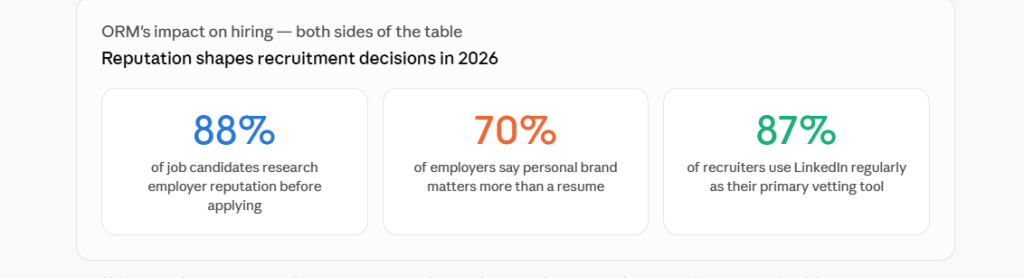
3. It influences hiring. Research shows up to 88% of qualified job candidates research a company’s employer reputation before applying. And 70% of employers now say a candidate’s personal brand matters more than their resume. ORM affects talent attraction on both sides.
4. It builds long-term trust. Unlike paid advertising (which stops when you stop paying), a strong reputation compounds over time. Positive reviews, consistent social presence, and good media coverage create durable credibility.
5. It controls the first impression. Roughly 25% of searches end without a click — users form opinions from what appears in the results themselves. ORM is the only tool that shapes what that first impression actually says.
Online Reputation Management Tools
These are the tools most used by ORM professionals, from free to paid:
Google Alerts — Free. Set up alerts for your brand name, founders, and products. Google emails you whenever new content mentions your terms. The simplest and most essential ORM tool.
Brand24 — Paid (with trial). Real-time monitoring across social media, blogs, news, and forums. Good for tracking brand sentiment and mention volume.
Mention — Paid. Strong social listening features and team collaboration tools for managing multiple brand accounts.
SEMrush — Paid. The brand monitoring feature tracks mentions alongside your SEO data — useful for connecting ORM with search performance.
BirdEye / ReviewTrackers — Paid. Platforms specifically for managing reviews across Google, Trustpilot, Justdial, and other platforms. Best for businesses with high review volume.
Google Business Profile — Free. Claiming and optimising your Google Business Profile is the single most impactful ORM action for any local or small business.
ORM and Personal Branding — Why Students Should Care
ORM is not only for companies. For individuals — especially students entering the digital marketing job market — personal reputation management matters.
82% of people trust a company more when its senior leaders are active on social media. 87% of recruiters use LinkedIn regularly and say it is the most effective method for vetting candidates (Source: Link)
Every JSDM student is a personal brand. Building an active LinkedIn profile, a clean social media presence, and some published content or portfolio work during your course — not after — is ORM in practice.
Where to Learn These Skills Properly
Understanding ORM in theory is one thing. Knowing how to audit a brand’s reputation, set up monitoring, generate and respond to reviews, suppress negative results, and measure improvement is a career-level skill employers actively look for.
JSDM — Jaipur School of Digital Marketing covers Online Reputation Management as part of its comprehensive digital marketing course in Jaipur, alongside SEO, social media, content strategy, paid advertising, and analytics. The curriculum is built around current industry practice, so what you learn applies from the first day of work.
If ORM is a skill you want to build, JSDM gives you the practical foundation to build it properly.
FAQs
What is the difference between ORM and PR?
PR manages media coverage and earned publicity — primarily through journalists and press releases. ORM is broader: it uses SEO, content marketing, review management, and crisis response to shape everything visible when someone searches your brand online. PR is one tool inside an ORM strategy, not the same thing.
Does online reputation management affect Google rankings?
Yes, directly. Review signals — including volume, velocity, and sentiment — are projected to account for 20% of local search ranking factors in 2026. Active brand mentions, strong Google Business Profile ratings, and positive content all contribute to search performance. ORM and SEO overlap significantly.
What ORM tools are free to start with?
Google Alerts is completely free and essential — set up alerts for your brand name immediately. Google Business Profile is also free and the most impactful single ORM action for any business. Paid tools like Brand24, Mention, and BirdEye offer trials. For beginners, starting with the free tools while learning the strategy is the right approach.
How much does Online Reputation Management cost?
Basic ORM can be handled in-house for free using tools like Google Alerts and Google Business Profile. Specialized ORM software or hiring an agency typically ranges from basic subscription fees for tools ($50–$200/month) to full management retainers for businesses facing active reputation crises.
How long does it take to repair a damaged online reputation?
This depends on how visible and well-established the negative content already is. With regular positive content generation and inflow of reviews, a recent negative review or article can be pushed away to pages 2–3 in a matter of 2–3 months. Negative content that is well anchored through extensive backlinking may take six to twelve months before there are any meaningful improvements. It does not have an instant solution — ORM is a constant process rather than a one-time action.