Conversion rate optimization (CRO) is all about having a larger number of users who visit your website take a valuable action, such as making a purchase, completing a form or subscribing. CRO means seeing how visitors use your website, trying small changes, and keeping the ones that work best. Digital marketing courses may be an excellent starting point for someone who is completely new to this concept.
Think about it this way. You spend money on ads and SEO to bring people to your website. Then most of them leave without doing anything. CRO fixes that leak. Same traffic, better results. When you want to go deeper into testing and data, the Advanced Digital Marketing Course is the next step.
In this guide, we will explain the CRO meaning in simple words. You’ll also learn how to calculate your conversion rate, follow a clear conversion rate optimization process, see some easy conversion rate optimization examples, and pick the right CRO tools to start with.
What Is Conversion Rate Optimization? (CRO Meaning)
The CRO meaning is easy. A conversion is any action you want a visitor to take. Conversion rate is the percentage of visitors who take it. Optimization means improving that percentage, step by step.
A conversion is not always a sale. It depends on your business.
- Online store: a purchase
- Coaching institute: a demo class booking
- Blog: a newsletter signup
- Software company: a free trial start
CRO works on what you already have. Your pages, forms, buttons and offers. You’re not chasing more traffic. You’re making better use of the traffic that has already arrived.
One more thing. CRO is not guessing. Changing a button colour because it “looks nicer” is not CRO. Real conversion optimization starts with data and ends with a test.
How to Calculate Conversion Rate (Formula + Example)
There are two common ways to calculate it. The first is visitor-based:
Conversion Rate = (Unique visitors who converted / Total unique visitors) × 100
The second is session-based:
Conversion Rate = (Sessions with a conversion / Total sessions) × 100
Both are fine. Just pick one and stick with it, or your numbers will never match. In GA4, the actions that matter to your business are marked as key events, so set those up first. Don’t count every event as a conversion.
A simple example. Your online store gets 2,000 visitors in a month. 60 of them buy. So 60 ÷ 2,000 × 100 = 3%.
Now add money to it. Say the average order is ₹2,000.
- At 3%: 60 orders = ₹1,20,000
- At 4%: 80 orders = ₹1,60,000
Same 2,000 visitors. ₹40,000 more. This only holds if your traffic and order value stay the same. But you can see why even a 1 percentage point lift matters.
Macro vs Micro Conversions
Not every conversion is a big one. If you track only sales, you miss a lot.
| Type | What it means | Example |
| Macro conversion | Your main goal | Purchase, demo booking, enquiry form |
| Micro conversion | A small step toward the goal | Add to cart, newsletter signup, watching a product video |
Why does this matter? Say 1,000 people add a product to cart, but only 30 pay. Now you know the problem sits somewhere between the cart and the payment page. Without micro conversion data, you’d never see it.
What Is a Good Conversion Rate?
There’s no single right answer. Your number depends on:
- Your industry
- Where the traffic comes from (ads, SEO, email, social)
- Product price
- Device (mobile or desktop)
- How you define a conversion
A ₹500 product and a ₹5 lakh service will never convert the same way.
The best benchmark is your own past data. Check the last three months. Then try to beat it. If you compare with others, compare only similar pages with similar traffic.
Why Is CRO Important?
Because traffic costs money, and CRO makes every visit count more.
- More revenue from the same traffic. You don’t need a bigger ad budget to grow.
- Lower cost per customer. If more visitors convert, each lead costs you less.
- Better user experience. Faster pages, clearer forms, simpler checkout. People feel the difference.
- Better decisions. Tests show what your audience really does, not what you think they do.
Some businesses raise their ad budget when the real problem is the landing page. Look at the page experience before you spend more. It can show whether your existing traffic is being used well.
CRO vs SEO: What Is the Difference?
| SEO | CRO | |
| Main goal | Get more people to find your site | Get more of those people to take action |
| Works on | Keywords, content, backlinks, site health | Page design, copy, forms, offers, speed |
| Key numbers | Impressions, clicks, rankings | Conversion rate, leads, sales |
They’re not rivals. SEO fills the bucket. CRO fixes the holes in it. If you do only SEO, you get visitors who don’t act. If you do only CRO, you may have too little traffic to test properly.
Conversion Rate Optimization Process (Step by Step)
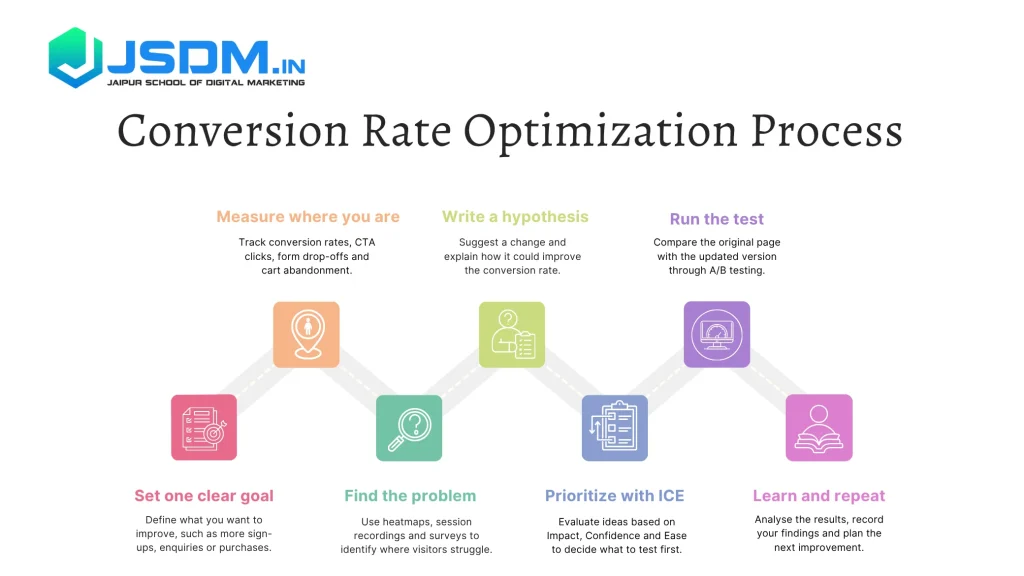
A good CRO strategy is not a list of random tweaks. It’s a loop. This is the conversion rate optimization process I’d follow on any website.
- Set one clear goal. For example, more demo bookings or more checkouts. Then decide which conversion tells you the goal is met.
- Measure where you are. Before you change anything, know your numbers. Look at conversion rate, form drop-offs, cart abandonment, CTA clicks and device-wise results. You don’t need all of them. Pick the ones that match your goal. And don’t swap conversion rate for bounce rate or engagement rate. They tell different stories.
- Find the problem. Use heatmaps, session recordings and short surveys to see where people get stuck. Also read your own page like a first-time visitor.
- Write a hypothesis. It’s an educated guess you can test. Use this format:
If we [make this change], then [this number] will improve because [this reason].
Example: If we cut the enquiry form from 7 fields to 4, form submissions will go up because it takes less effort. - Prioritize with ICE. You’ll have many ideas. Score each one from 1 to 10 on three things: Impact (how big can the win be?), Confidence (how strong is your proof?) and Ease (how simple is it to build?). Start with the highest total.
- Run the test. In an A/B test, half of your visitors see the original (the control) and half see the new version (the variant). Keep it running until you have enough data for a reliable comparison. How long that takes depends on your traffic, your current conversion rate and how big a change you want to detect. Don’t stop just because one version leads for a few days. Early leads often fade.
- Learn and repeat. Win or lose, you learned something. Write it down. Then pick the next idea.
Conversion Rate Optimization Examples
These examples show the idea. They’re illustrations, not results from a real client.
Ecommerce: fix checkout friction
- Problem: Many shoppers add products to cart but don’t pay.
- Change: Show delivery cost early and allow guest checkout.
- What to expect: Fewer drop-offs at checkout, so more orders. Test it to confirm.
Lead generation: shorten the form
- Problem: A service page gets visits but few enquiries.
- Change: Cut the form from 7 fields to 4. Ask only for name, phone, email and need.
- What to expect: Less effort, so more completed forms. Also watch lead quality.
Education or service: build trust
- Problem: Visitors read the course page but don’t book a call.
- Change: Add student reviews, a clear fee section and a button that says “Book a Free Counselling Call”.
- What to expect: More trust, so more calls.
See the pattern? One change, one reason, one number to watch.
CRO Best Practices
- Give each page one clear main action. Too many competing buttons can confuse people.
- Use CTA text that tells people what happens next. “Get my free quote” is clearer than “Submit”. Test it on your own page.
- Keep pages fast. Many visitors browse on phones, so check your pages there first.
- Place trust signals near key decisions. Reviews, numbers, logos or certificates near the button or form.
- Keep forms short. Ask only what you really need.
- Test with a clear purpose. Changing one thing at a time makes it easier to see what worked.
CRO Tools for Beginners
| Tool | What it does | Cost |
| Google Analytics 4 (GA4) | Shows conversions, traffic sources and funnels | Free |
| Microsoft Clarity | Heatmaps and session recordings | Free |
| Hotjar | Heatmaps, recordings and surveys | Free and paid plans |
| VWO | A/B testing | Paid |
| Optimizely | A/B testing and experimentation | Paid |
Start with GA4 and Clarity. They cost nothing. Add a testing tool only when your traffic is steady. Plans and prices change, so check each tool’s website before you pick one.
Common CRO Mistakes to Avoid
- Testing without data. Random ideas waste weeks.
- Ending a test too early. Early leads often disappear.
- Changing too many things without a plan. It gets hard to tell what worked.
- Copying a competitor. Their audience is not yours.
- Judging only by conversion rate. A page can convert more people and still bring poor leads. Check lead quality and revenue too.
How to Measure Conversions from AI Search Traffic
More people now get answers from AI tools like ChatGPT, Perplexity and Google’s AI answers. Some of them click through to websites. How much traffic that sends, and how well it converts, is different for every business. So don’t assume anything. Measure it.
- Look for referral traffic from AI platforms in GA4 where you can. Compare its conversion rate with your other channels.
- Check that your landing page matches what the AI answer promised.
- Remember that some AI-driven visits may show up as direct traffic, so the numbers won’t be perfect.
- Keep key details easy to find: what you offer, price range, how to contact you.
How to Build CRO Skills as a Beginner
CRO is a skill you can learn step by step. Start here:
- GA4 basics
- Reading user behaviour with heatmaps and recordings
- Landing page optimization
- A/B testing basics
- Writing a clear hypothesis
- Reading data without jumping to conclusions
Then practice on a real page. Your own site, a friend’s shop or a small project. Nothing teaches like running one real test.
Want a guided path? JSDM’s Digital Marketing Courses are a good place to start. When you’re ready for greater skills, the Advanced Digital Marketing Course is the next step.
Conclusion
CRO is not a trick. It’s a habit. Look at the data, make one small change, test it, and learn from it. Start with one page, one goal and one test. A small lift on a page with steady traffic adds up over the months.
CRO FAQs
Q1. What is a CRO strategy?
Ans: A CRO strategy is a plan to raise conversions on purpose. You start with a business goal, measure your numbers, find where people get stuck, write hypotheses, test them and repeat.
Q2. What is a good conversion rate?
Ans: It depends on your industry, traffic source and what you count as a conversion. Compare yourself with your own past numbers first.
Q3. Is CRO the same as SEO?
Ans: No. SEO brings visitors to your site. CRO helps those visitors take action. They work best together.
Q4. How long should an A/B test run?
Ans: Long enough to collect enough data for a reliable comparison. The time depends on your traffic, your current conversion rate and the change you want to detect. Don’t stop a test just because one version leads for a few days.
Q5. Can I do CRO with low traffic?
Ans: Yes. Start with research instead of tests. Watch recordings, run a short survey and fix obvious problems like slow pages or long forms. When you test, try bigger changes and give them more time.
Q6. Is CRO a good career?
Ans: Businesses always want more from the traffic they already pay for, so the skill is useful. It also pairs well with SEO, ads and analytics.
Q7. How long does CRO take?
Ans: CRO is not a one-time fix. A first round of research and tests can take a few weeks, depending on your traffic. After that, you keep testing and improving over time.
Q8. Can CRO increase sales without more traffic?
Ans: Yes. That’s the whole idea. CRO helps more of your current visitors take action, so sales can grow without extra traffic or ad spend.