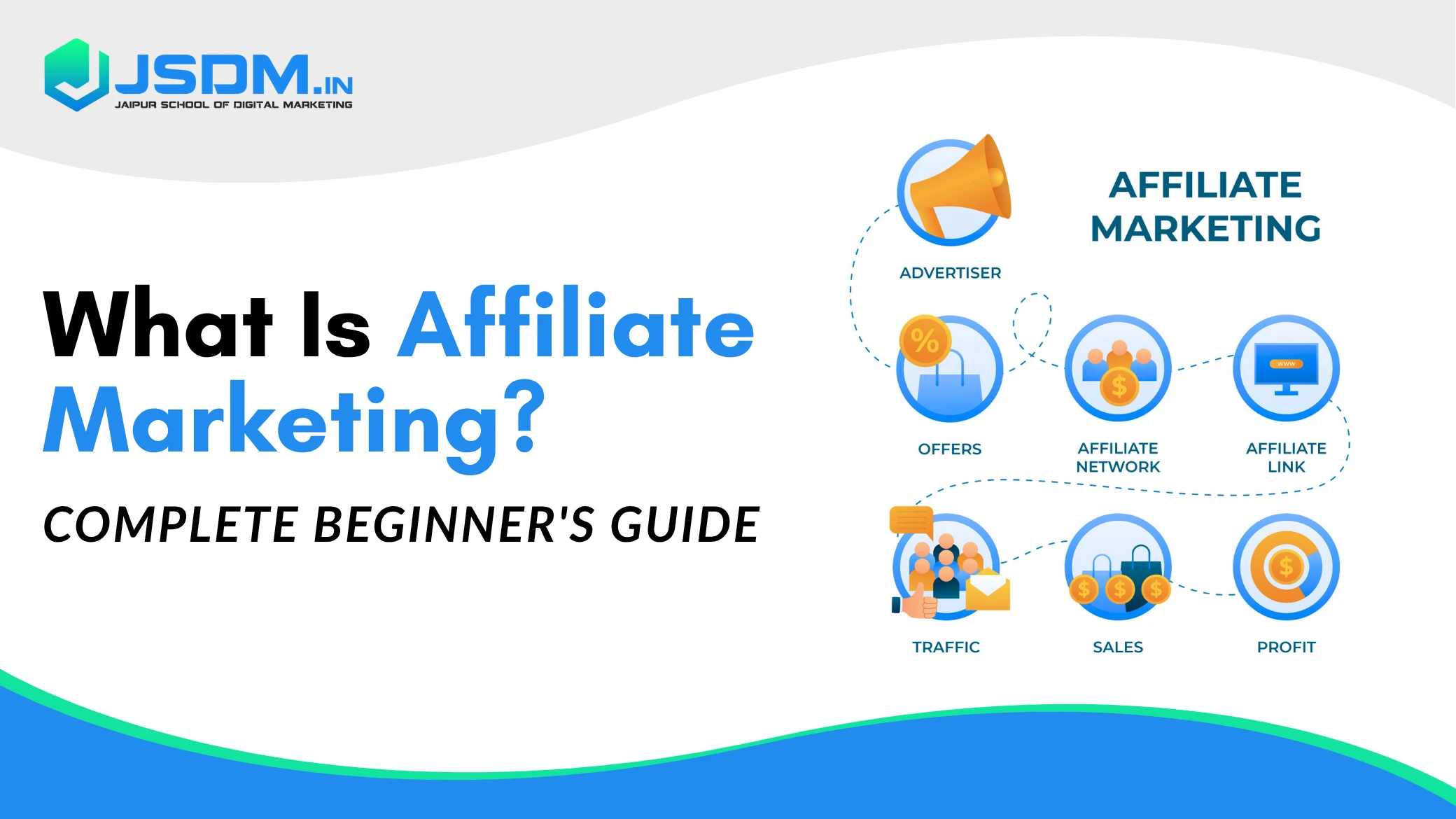
Affiliate marketing is a way to earn a commission by recommending another company’s product or service. You share a special tracking link. When someone buys, signs up or takes the action through your link, the company pays you a part of the sale. It is also one of the practical skills you pick up in a digital marketing course, because it brings content, traffic and tracking together.
You do not make the product. You do not handle delivery or customer support. Your job is to bring the right person to the right offer. That is why many beginners in India start here. But it is not “easy money”. It is a skill, and it pays only when people trust what you say. Good digital marketing training helps with this, since you learn how to build that trust through SEO, useful content and honest reviews.
Table of Contents
ToggleHow Does Affiliate Marketing Work?
The process is simple once you see it in order.
- A company (the brand) like Amazon runs an affiliate program.
- You join the program and get a unique link.
- You share that link in a blog, video, social post or message.
- A person clicks it. The program records the referral with its tracking system. Depending on the program, this may use cookies or other methods.
- If that person completes the required action within the program’s time window, the referral may qualify for a commission.
- The company pays you a commission after its checks are done.
The checks matter. Brands usually do not pay for orders that are cancelled, returned or marked as fake. So your earnings are not final on the day of the sale. It is final when the brand confirms it.
Here is an example. Say you write a review of a budget laptop. A reader clicks your link and buys it. The shopping site pays you a small percentage. The reader pays the same price as always. Your link did not make it costlier.
Who Are the Key Players in Affiliate Marketing?
Four parties are involved. Knowing them helps you read any program’s terms.
- Merchant (advertiser): The brand that sells the product or service.
- Affiliate (publisher): You. A blogger, YouTuber, page owner or deal-site owner who promotes the offer.
- Affiliate network or platform: The middle layer that gives you links, tracking and payouts from many brands in one place.
- Customer: The person who clicks and buys.
Some brands run their own program directly. Others use a network. As a beginner, a network saves time because one sign-up gives you access to many brands.
Types of Affiliate Marketing
Affiliate marketing is often grouped into three broad types, based on how close you are to the product or audience. These are useful to understand different approaches, though not every program uses them formally.
- Unattached: You run ads or share links with no link to the topic or your own authority. It may be harder to build trust this way.
- Related: You promote offers in a niche where you have some audience or content, but you do not claim to have used the product.
- Involved: You promote only what you have used. You share your honest results, good and bad. This type builds the most trust, and it is the one I suggest to every beginner.
If you want long-term income, aim for the “involved” type. People can feel the difference between a real recommendation and a copied one.
Affiliate Marketing Commission Models: How Do You Get Paid?
Brands pay in different ways. The payment depends on what action they want from the visitor.
| Model | What it means | Common payment trigger |
| Pay per sale (PPS) | You earn when someone buys | A completed purchase |
| Pay per lead (PPL) | You earn when someone shares details | A form fill, free trial or signup |
| Pay per click (PPC) | You earn for clicks | A valid click on your link |
| Recurring commission | You keep earning while the customer stays | Usually starts with a sale or signup, then repeats each billing cycle |
Recurring is a payment structure, not a separate trigger. It is common in software subscriptions. One customer can pay you every month as long as they stay subscribed.
Pay-per-click affiliate programs pay for qualifying clicks, not completed sales. Availability and eligibility vary by program, so check the payment terms before joining. Most programs you will see are pay per sale or pay per lead.
Commission rates differ a lot. Physical products often pay a small percentage. Software and online courses often pay more. Always read the program page for the current rate, cookie time and payout rules before you promote anything.
Affiliate Marketing Channels: Where Can You Promote?
You do not need all of these. Pick one and learn it well.
- Blog or website: Reviews, comparisons and how-to guides. Search traffic can keep bringing readers for months.
- YouTube: Product demos and tutorials. Viewers trust what they can see.
- Instagram and Reels: Quick tips, outfit or gadget picks, and deal posts.
- WhatsApp and Telegram groups: Deal alerts. These work only if the group trusts you and you do not spam.
- Email newsletter: Direct access to people who asked to hear from you.
- Comparison and coupon sites: Useful for shoppers who already want to buy.
Content that answers a real question usually performs better than plain link dropping. A reader who is ready to decide wants a clear “which one should I buy” answer.
Affiliate Marketing Programs and Platforms in India
There are two things to look at: the affiliate marketing programs (offers from brands) and the affiliate marketing platforms (places that connect you to them).
Program, network and platform: what is the difference?
- An affiliate program is one brand’s offer. For example, Amazon’s program pays you for sales of its products.
- An affiliate network connects you to many brands’ programs in one account.
- An affiliate marketing platform is the tool or app you use to get links, track clicks and see payouts. Some networks are also platforms.
So a brand has a program, and you may reach it through a network or platform.
Programs you can join directly
- Amazon Associates India, for products sold on Amazon. Read its operating agreement first. It has rules on disclosure, linking and payouts.
- Programs run by individual brands, such as web hosting companies, software tools and course providers. Look for an “Affiliate” or “Partners” link in the website footer.
Platforms and tools
- Cuelinks: An India-based platform that helps bloggers and content sites turn links into affiliate links. It gives access to merchant campaigns and reports. See what Cuelinks says about itself.
- EarnKaro: An Indian deal-sharing platform where users share partner brand deals and earn when someone buys through their link. Read its terms before you start.
- Global networks: Some international networks also accept Indian publishers, though payment and tax steps can be harder.
| Option | What it is | Best suited for | What to check |
| Amazon Associates India | Direct affiliate program | Product reviews and shopping picks | Commission rates, qualifying purchases, linking and disclosure rules |
| Cuelinks | Publisher monetisation platform | Bloggers and content sites | Merchant availability, campaign terms, payout rules |
| EarnKaro | Deal-sharing platform | People sharing deals through permitted channels | Supported brands, allowed sharing methods, confirmed-profit rules |
No single option is best for everyone. It depends on your niche and channel.
A few rules I follow when choosing:
- Check that the platform or brand pays on time and shows clear reports.
- Be careful if someone asks for a fee to guarantee approval or earnings. Verify the program on the brand’s official website, read its terms and confirm any charges before paying.
- Read the terms about where you may and may not post your link.
- Rates, approval rules and payout limits change. Confirm them on the official page before you plan around them.
How to Start Affiliate Marketing Step by Step
If you are wondering how to start affiliate marketing, follow this order. Do not skip the first two steps. Most beginners do.
- Pick a niche you understand. Choose something you already know or can learn deeply, like personal finance, fitness, tech, parenting or online courses. Passion helps, but you also need people willing to spend money on it.
- Know your reader. Write down who they are and what problem they want solved. “Best laptop under ₹40,000 for students” is better than “laptops”.
- Choose one channel. Start with a blog, a YouTube channel or one social page. Focus on it until you understand its content, traffic and conversion patterns. Add another when you can keep the quality up.
- Join two or three programs. Pick offers you can honestly recommend. Do not join twenty.
- Create helpful content. Compare products, show real use, list pros and cons and say who should not buy. Honest content converts better in the long run.
- Add your links and disclosure. Put the disclosure near the link, not hidden at the bottom.
- Get traffic. Use SEO, social posts, email or community groups. This is the slowest part, and it is normal.
- Track and improve. Check which pages get clicks and which get sales. Update the weak ones.
If you want to learn the traffic part properly, a structured Digital marketing course that covers SEO, social media, email and analytics will make steps 7 and 8 much easier. Affiliate marketing runs on the same skills.
How Much Can a Beginner Earn from Affiliate Marketing?
No one can promise you a number. Earnings depend on your niche, traffic, trust, the commission rate and how well your content matches buyer intent.
Here is the honest picture:
- Many beginners earn nothing in the early period. That is normal while you build content and traffic.
- Some earn small amounts first, often from a few well-written pages.
- A smaller group builds steady income by running a focused site or channel for a long time.
Here is a simple example. Say a product sells for ₹5,000 and the commission rate is 4%. One approved sale gives you ₹200. If the order is cancelled or returned, you may get nothing. Rates and rules differ by program, so this is only a way to understand the math.
There is no fixed timeline. Anyone who says “you will earn in 30 days” is selling something. Treat the first months as learning time, and measure progress by traffic, clicks and reader questions, not only by money.
Keep records of every payout and every cost, like hosting, tools and ads. You will need them at tax time.
A Simple Example: Budget Laptops for College Students
This is an illustrative example, not a real campaign or result. It shows how the steps fit together.
- Niche: Budget laptops for Indian college students.
- Content: One comparison page of three laptops, based on price, battery life and who each one suits.
- Links: Placed next to each recommendation, with a clear disclosure above the first link.
- Review: After a few weeks, check clicks, approved sales and conversion rate for that page.
- Next action: If a price or stock changes, update the page. If clicks are high but sales are low, check whether the picks match what readers want.
Notice that the work does not end after publishing. Updating the page is part of the job.
How to Track Your Affiliate Performance
Three words show up in every dashboard. Know the difference.
- Click: Someone opened your link.
- Conversion: That person did the required action, like buying or signing up.
- Approved commission: The brand checked the order and confirmed your payout.
Conversion rate is conversions divided by clicks. If 200 people click and 4 buy, your conversion rate is 2%. Look at it page by page. A page with many clicks and no sales often has a mismatch between the content and the offer. Fix that page before you write a new one.
Benefits, Challenges and Myths of Affiliate Marketing
Benefits
- Low starting cost compared to making your own product.
- No stock, delivery or customer support.
- You can work from anywhere.
- Good content can keep working for you over time.
Challenges
- Building trust and traffic takes patience.
- Commissions can change, and brands can end a program.
- Income is not steady in the beginning.
- You depend on the brand’s tracking and payment.
Common myths
- “It is passive income.” The setup is work, and old content needs updates.
- “Just put links everywhere.” Readers ignore pages that look like ads.
- “More programs mean more money.” Focus beats volume.
- “You need a big audience.” A small, trusting audience in one niche can convert well.
Disclosure, Income Tax and GST Basics in India
This part keeps you safe. This is general information, not legal or tax advice. Rules change, so confirm with the official sources and a chartered accountant.
Disclosure.
ASCI’s influencer advertising guidelines require clear disclosure when there is a material connection with a brand, including money or other benefits. ASCI lists labels such as “Ad”, “Sponsored”, “Partnership” and “Affiliate”. Place the disclosure where readers can see it without tapping “see more” or searching through hashtags.
For example: “Affiliate link: I may earn a commission if you buy through this link.” This is an example, not the only allowed wording. Amazon Associates also asks you to state that you earn from qualifying purchases, so read its agreement. Check the ASCI guidelines for rules on your platform and format.
Income tax.
Affiliate commission is income. Affiliate commission may be taxable as business or professional income, depending on your circumstances. Keep your payout statements and expense records. Check the Income Tax Department site or ask a CA for your case.
GST.
GST registration depends on your aggregate turnover, the nature and location of your supplies, and any exemptions or special rules that apply to you. If you get commissions from overseas companies, the treatment may also depend on the arrangement and place-of-supply rules.
Do not assume you are automatically exempt, or automatically required to register. Check the latest guidance on the GST portal and the CBIC GST FAQs, and talk to a chartered accountant if you are unsure.
How AI Helps in Affiliate Marketing
AI tools can save time, but they cannot replace your honest view.
- Research: Find questions people ask and group them by topic.
- Outlines: Build the first draft structure of a comparison post.
- Editing: Shorten long sentences and fix grammar.
- Ideas: Get video titles, hooks and email subject lines.
- Analysis: Spot which pages bring clicks and which need a fix.
What AI cannot do is use the product for you. Add your own photos, tests, numbers and opinions. That is what makes your page different from the thousand others on the same topic.
Common Affiliate Marketing Mistakes to Avoid
- Choosing a niche only because the commission looks high.
- Promoting products you have never used or checked.
- Hiding the disclosure.
- Writing like an ad instead of helping the reader decide.
- Joining too many programs and finishing none.
- Ignoring the program rules, like banned traffic sources or link placement.
- Giving up after a few weeks.
- Not tracking which content leads to sales.
Many beginners stop before their content has had enough time to attract consistent traffic. Consistency matters more than a perfect start.
Conclusion
Affiliate marketing is simple to understand and hard to master. You recommend something useful, the brand pays you for the result, and your income depends on how well you help the reader choose.
Start with one niche, one channel and two or three honest offers. Disclose clearly, keep your records and improve every month. To build the traffic skills behind this, you can look at Digital marketing training at JSDM, where students practise SEO, content and analytics on real projects.
Frequently Asked Questions
Q1. What is affiliate marketing in simple words?
Ans: It is a way to earn a commission by promoting another company’s product with your unique link. You get paid when someone buys or signs up through it.
Q2. Is affiliate marketing legal in India?
Ans: Yes. You should disclose your commission, follow the program’s rules and report your income as required by tax law.
Q3. Do I need a website to start affiliate marketing?
Ans: No. You can start with YouTube, Instagram or a newsletter. But always check if the program allows that channel.
Q4. Can a student do affiliate marketing?
Ans: Yes, students can explore affiliate marketing, but minimum-age and account requirements vary by program. Check the terms before registering, and ask a parent or guardian for help if you are under 18.
Q5. How is affiliate marketing different from dropshipping?
Ans: In affiliate marketing, the brand handles the sale, delivery and support. In dropshipping, you run the store and handle customer issues.
Q6. Which are the best affiliate marketing platforms for beginners in India?
Ans: Cuelinks and EarnKaro are commonly used by Indian publishers, and Amazon Associates India is a popular direct program. The best one is the one that has offers for your niche, pays reliably and has clear terms.
Q7. Do I have to pay tax on affiliate income?
Ans: Yes. Affiliate commission is taxable income. Speak to a CA about how to report it and whether GST applies to you.