Online advertising is a significant part of marketing today, providing companies several ways to reach their desired markets. Two common online advertising models are Cost-Per-Click (CPC) and Cost-Per-Acquisition (CPA). Both have their benefits, drawbacks, and best uses.
Digital marketing classes are always here to give you the necessary information regarding CPC and CPA. Knowing the differences between these two models is key to optimising your ad budget. This article will present the primary key differences between CPC and CPA to help you decide on the best choice for your campaigns.
Table of Contents
ToggleMeaning of CPC (Cost-per-Click)
CPC is an advertising tool for your ads, and you have to pay somebody to click on your ads. This naturally works on common platforms like Google and Facebook Ads. It is precious for your website to get a good reach of your audience, and it also delivers organic results for all your advertisements.
Meaning of CPA (Cost-per-Acquisition)
CPA is a payment procedure that makes the person pay only when they reach a specific action, like purchasing something, signing up, or downloading something. The method is widely involved in affiliate marketing and other performance-based buildups.
Comparison Between CPC and CPA
| Outlook | CPC | CPA |
| Meaning | Pay for every click on an advertisement. | Pay for each action taken or conversion achieved. |
| Specialties | use for engaging traffic on the website. | Getting particular results like normal sign-ups and registration. |
| Suitability | It is the best for brand awareness and generating traffic. | It is the best for lead generation and sales. |
| Payment Way | Ad clicks. | Desired action completion. |
| Level of Risk | Higher Level of Risk. | Lesser Level of Risk. |
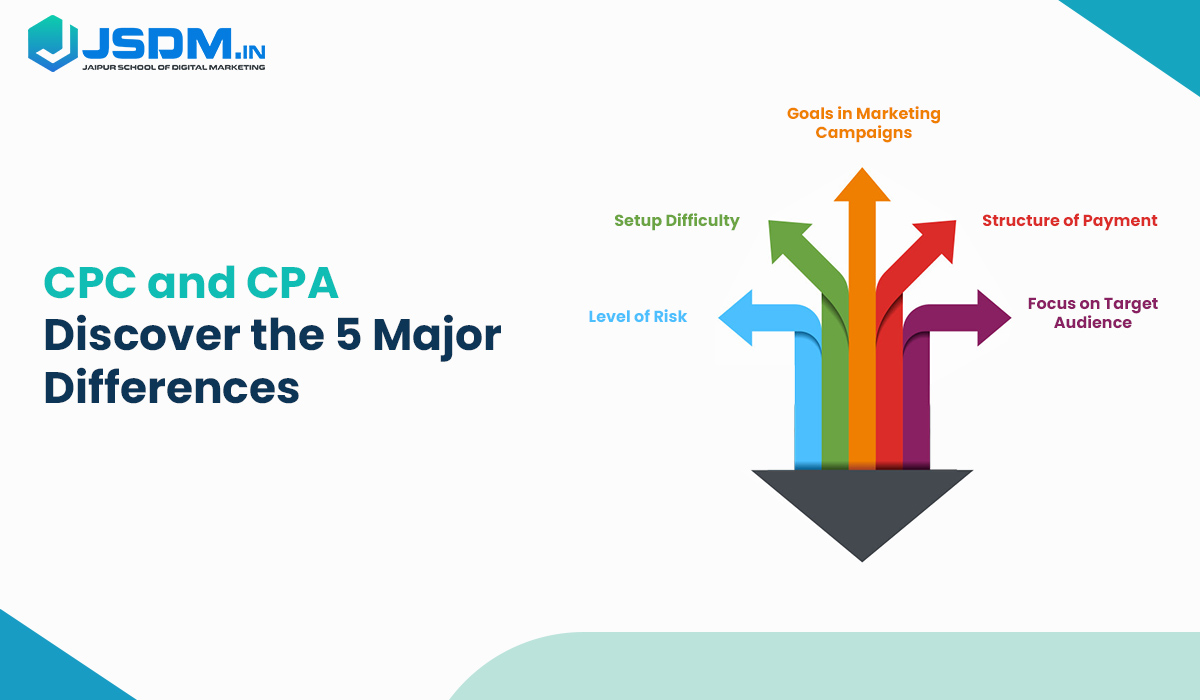
5 Major Differences Between CPC and CPA
Here are the main points of differences between CPC and CPA in digital marketing.
Goals in Marketing Campaigns
CPC
This model works well for campaigns that aim to boost website visits or brand awareness. It has often been used when the main aim is to attract more visitors.
CPA
This model is more appropriate for campaigns that seek specific results, such as sales or generating leads. It emphasizes achieving measurable results instead of just increasing traffic.
Setup Difficulty
CPC
Establishing a CPC campaign is usually simple and requires low technical skills. Advertisers can start advertising by using simple, tender methods.
CPA
Conversely, a CPA campaign can be difficult to set up because it often requires a tracking tool, such as Google Analytics or Facebook Pixel, to track conversions accurately.
Structure of Payment
CPC
In the CPC method, advertisers have to pay for each click on their ad, whether or not the click on the ad can lead to a conversion. For example, if 2000 people click on that particular click and the CPC of an ad is Rs2, then the total cost would be Rs4,000.
CPA
Under the CPA method, advertisers pay only for a specific action, such as purchasing or signing up from a specific location. This means that if 20 out of 2000 clicks result in purchases and sales, then the advertiser pays only for those 20 particular actions.
Focus on Target Audience
CPC
This method is used by users searching for their purchase options, such as thinkers or product experts who do not plan to buy immediately. For example, a food brand can use CPC ads to attract eager visitors to its products.
CPA
On the other hand, CPA targets users who are ready to work and who want to buy or register for services. By focusing on this group, advertisers can increase the conversion rate and ensure that their advertising expenses can lead to real results.
Level of Risk
CPC
This model includes higher risk because advertisers pay in advance for every click, although the clicks do not lead to income or leads. If an ad receives many clicks but few conversions, the advertiser should lose a substantial amount of cash on visitors who do not produce outcomes.
CPA
In evaluation, CPA offers a lower risk for advertisers because they only pay when actual conversions occur. This performance-based method reduces the monetary risk linked to unproductive clicks.
Additional Considerations of CPC and CPA
Marketers should identify the biggest differences between CPC and CPA and how these models can collaborate in a major advertising plan. PPC training is available here to help you understand the concept of CPC and CPA concerning digital marketing.
- Using Both Models: Advertisers can implement both CPC and CPA in the same campaign. For example, they can start with CPC to attract early visitors and then switch to CPA as they target the audience to promote adaptation.
- Budget Management: Smart budget management can improve the overall marketing results between CPC and CPA campaigns. By reviewing the previous data on the conversion frequencies and click-through Rates (CTR), advertisers can decide where to use the best of the budget for the greatest impact.
- Monitoring Performance: It is important to check regular expedition measurements to improve both CPC and CPA approaches. Important indicators such as CTR, conversion frequency and investment returns (ROI) should often be reviewed to evaluate how well each model works.
Conclusion
Choosing between CPC and CPA depends on the advertiser’s goals, the amount of risk they can manage, and their financial flexibility. CPC is fantastic for bringing traffic and increasing logical visibility, while CPA is better for focusing on average conversions. Digital marketing coaching is always available to help you know more about different concepts related to digital marketing.